Elevation Craft

Projects / electrical · woodworking

Truck camper build-out: cabinetry, 12V power, and solar.

A pop-top truck camper turned self-sufficient basecamp: custom plywood cabinetry, an Epoch LiFePO4 house battery, and a full Victron charging and distribution system fed by solar and the truck's alternator.

A ground-up power and storage build for a Tune pop-top camper on a full-size pickup. The goal: work, cook, and sleep off-grid for days at a time, with the whole system monitored from a phone.

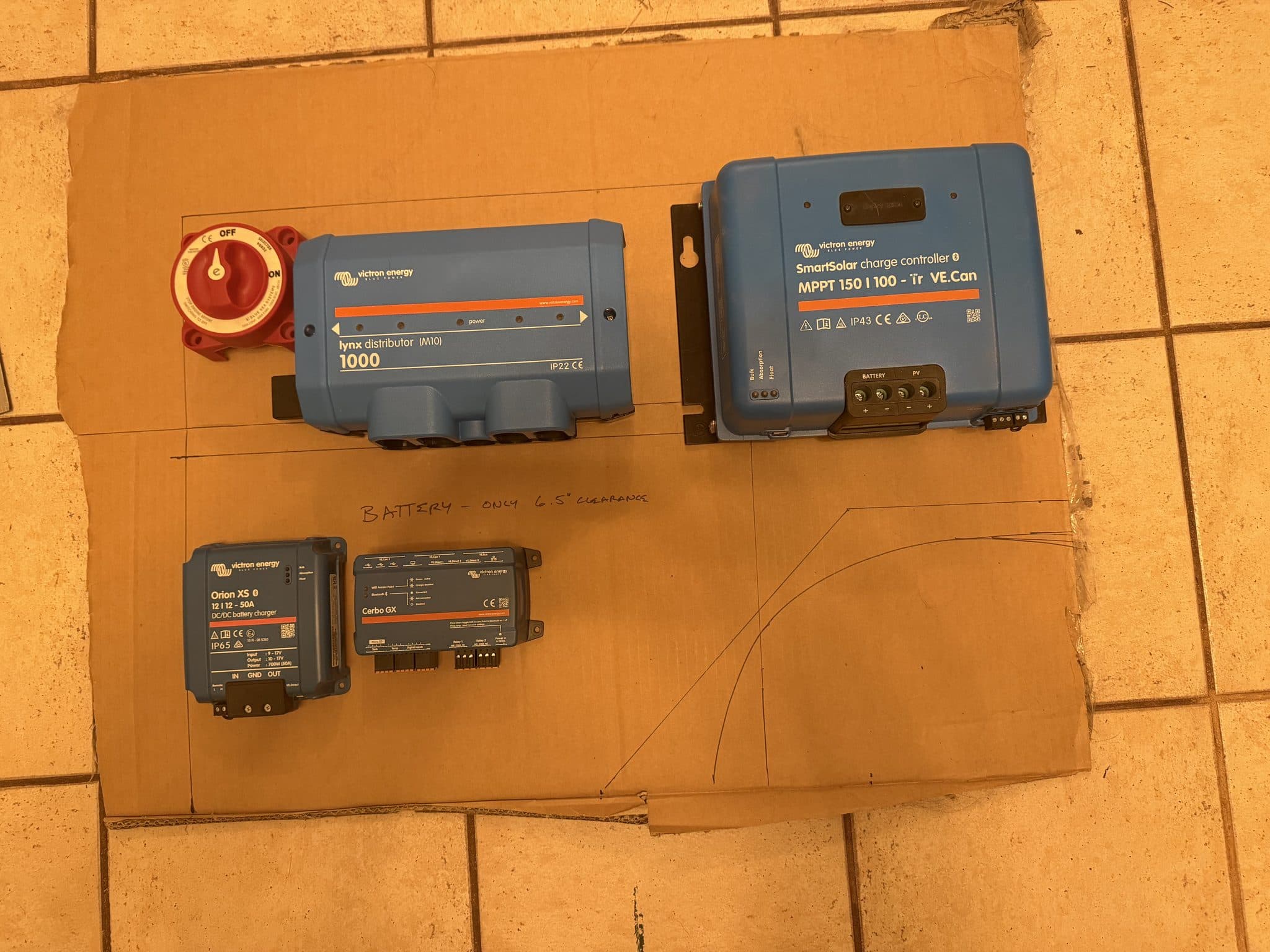
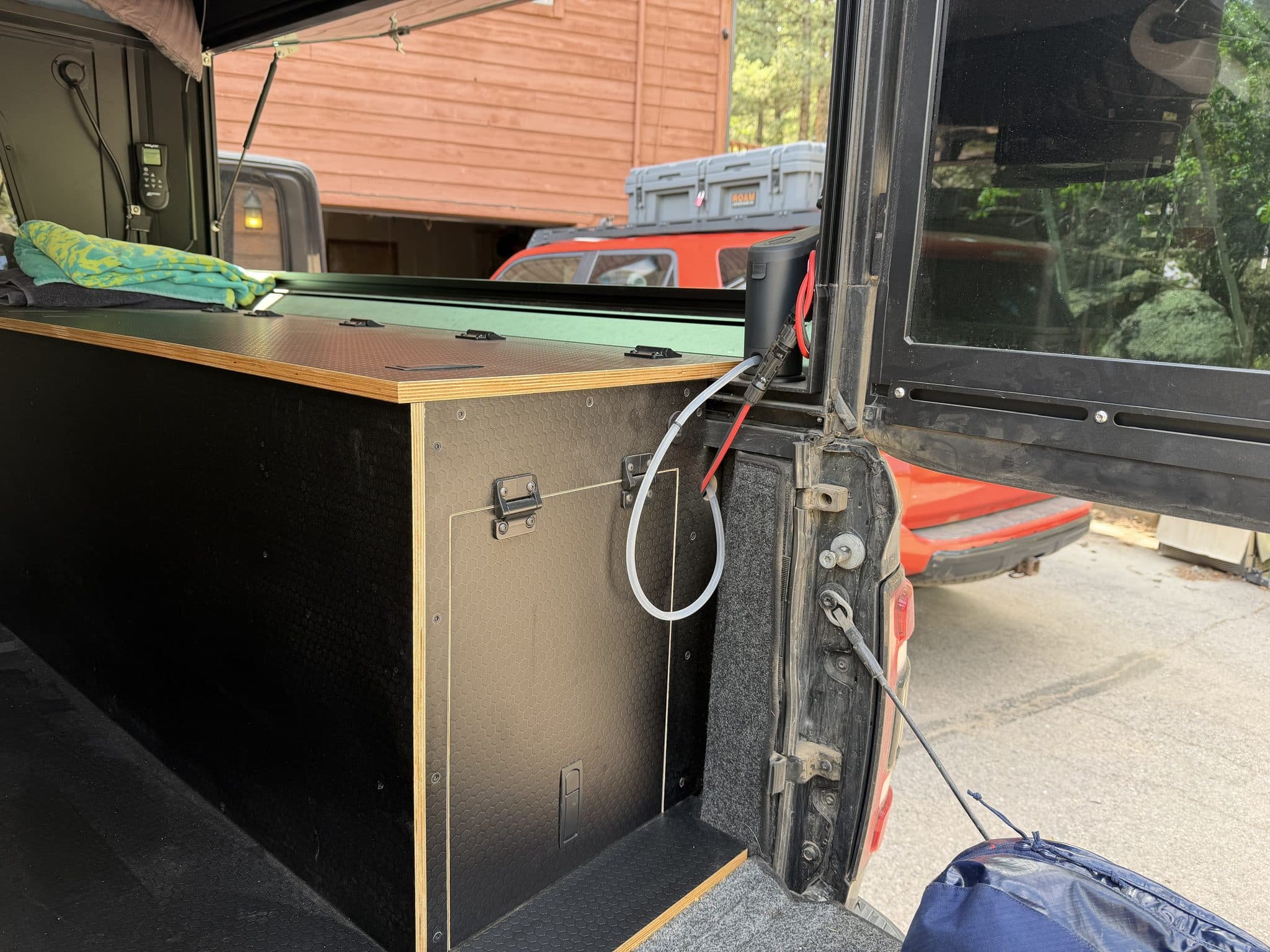
The electrical core is an Epoch LiFePO4 house battery feeding a Victron Lynx Distributor for fused DC distribution. Charging comes from two directions: a SmartSolar MPPT 150/100 charge controller on the solar side, and an Orion XS 12/12-50A DC-DC charger off the truck's alternator while driving. A Cerbo GX ties every component onto one network for monitoring and control, and a Blue Sea main battery switch isolates the bank for service. Solar lands through a weatherproof port at the bed rail with MC4 connectors, so panels can deploy without pinching wires in the tailgate.

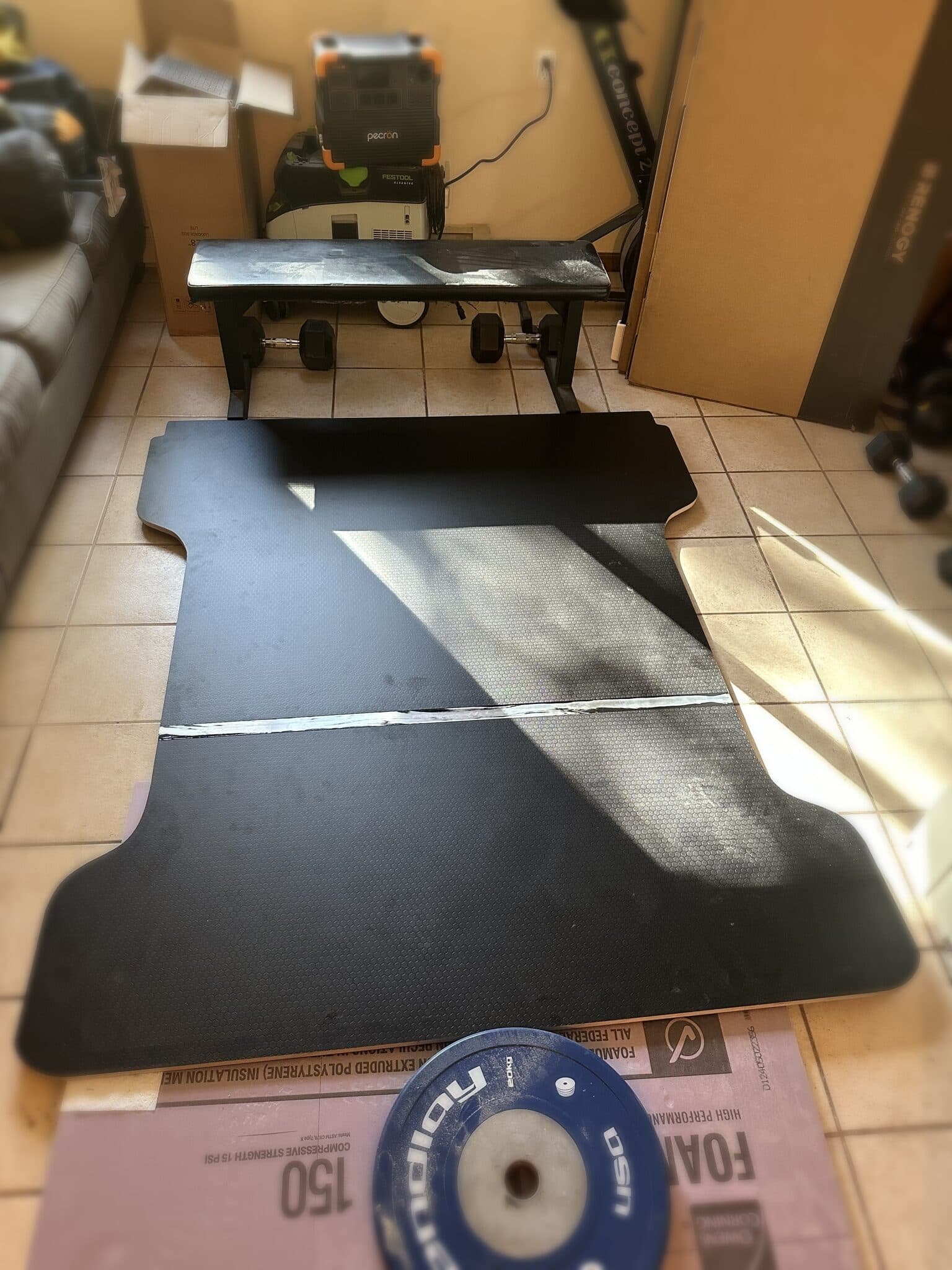
Before anything got mounted, the whole layout was mocked up full-scale on cardboard cut to the compartment's actual footprint — which is how a hard constraint like 6.5 inches of clearance over the battery gets caught on the living room floor instead of mid-install.

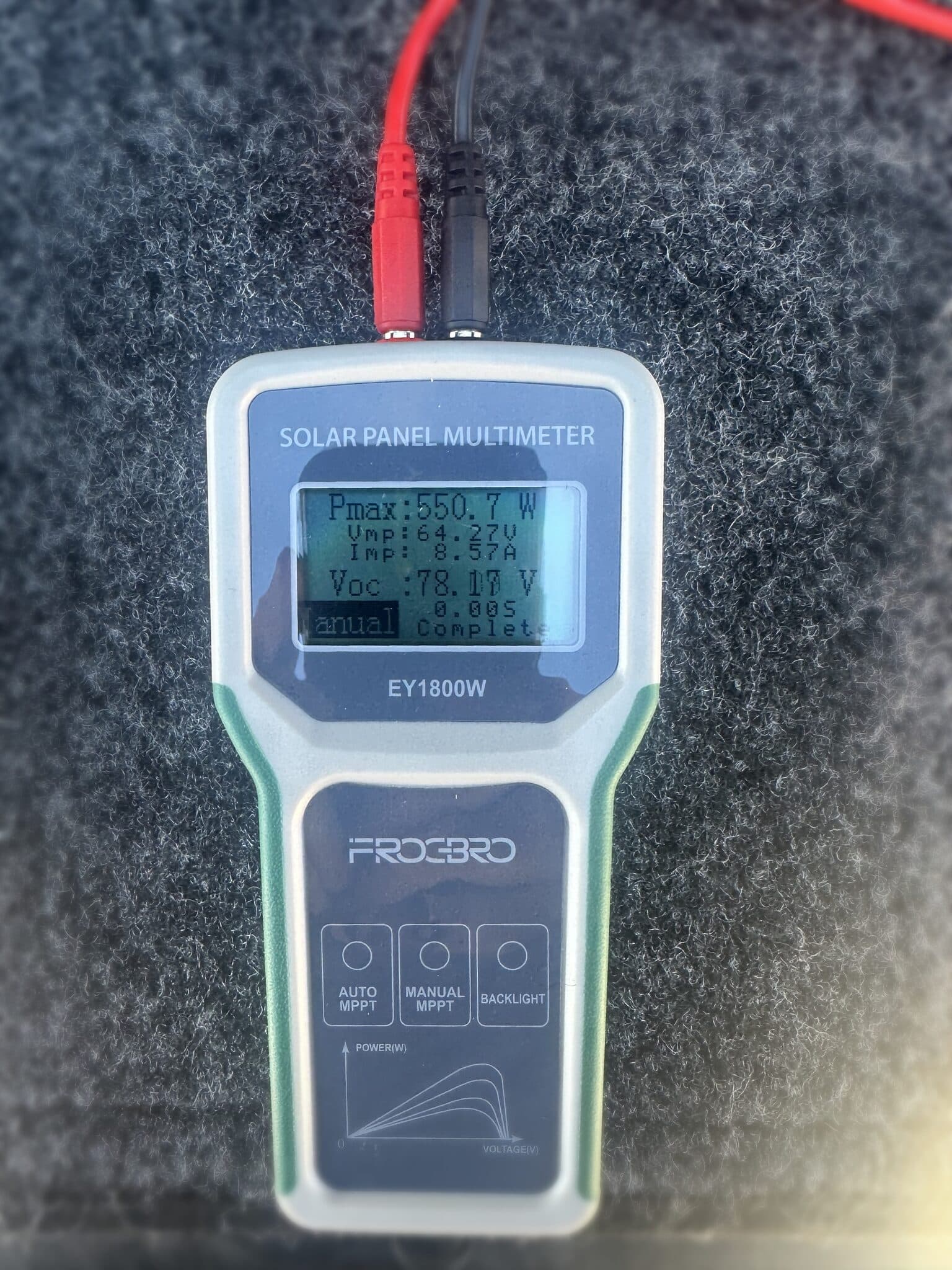
The cabinetry is modular: T-slot aluminum extrusion frames skinned in Baltic birch plywood faced with black hex laminate, built around the wheel wells. Each module carries its own wiring in braided sleeving, panels seat into felt-lined channels so nothing rattles on washboard roads, and a Lagun swing-arm table drops into a receiver on the bench box. Before the array went on the roof, every panel got bench-tested with a PV multimeter — 550 watts confirmed on the driveway, not discovered missing at camp. The result is a camper that runs a fridge, lighting, device charging, and a workstation indefinitely on sun and drive time.

Materials
Epoch LiFePO4 house battery, Victron Lynx Distributor 1000 (M10), Victron SmartSolar MPPT 150/100-Tr VE.Can charge controller, Victron Orion XS 12/12-50A DC-DC charger, Victron Cerbo GX monitoring hub, Blue Sea main battery switch, MC4 solar input port, T-slot aluminum extrusion module frames, Lagun swing-arm table mount, Baltic birch plywood cabinetry, black hex laminate
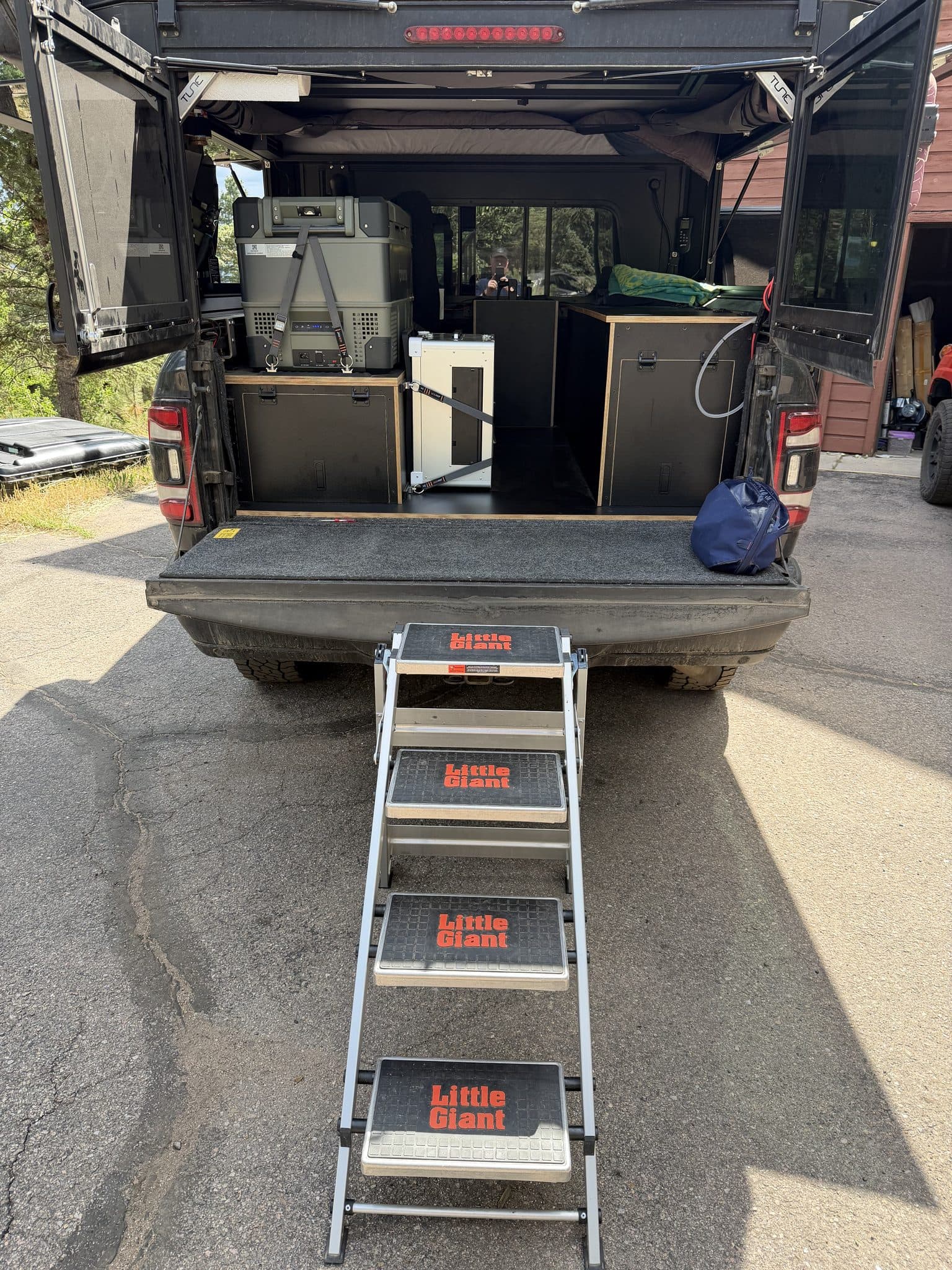
Rear view of the truck with tailgate down and camper doors open: fitted plywood cabinets on both sides, a fridge strapped to the driver-side platform, and folding steps leading up to the bed.

Gallery

Victron components laid out on a full-scale cardboard template of the electrical compartment: Lynx Distributor, SmartSolar MPPT 150/100 charge controller, Orion XS DC-DC charger, Cerbo GX, and a red Blue Sea battery switch, with a handwritten clearance note.
Full-scale cardboard mockup of the electrical bay. The note that matters: only 6.5″ of clearance over the battery.
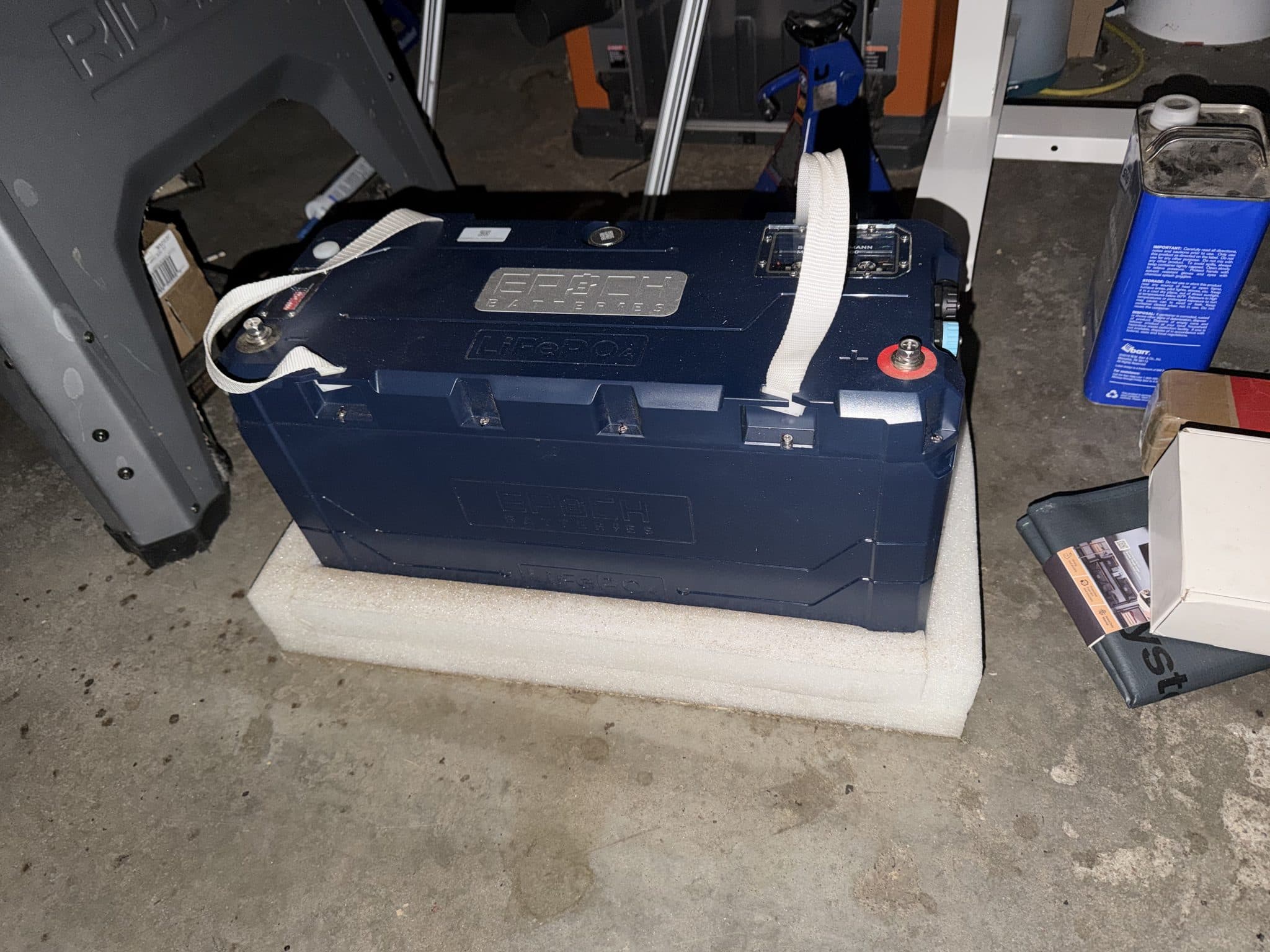
Epoch Batteries LiFePO4 house battery resting on foam padding in the garage before installation, lifting straps still attached.
The house battery: Epoch LiFePO4.
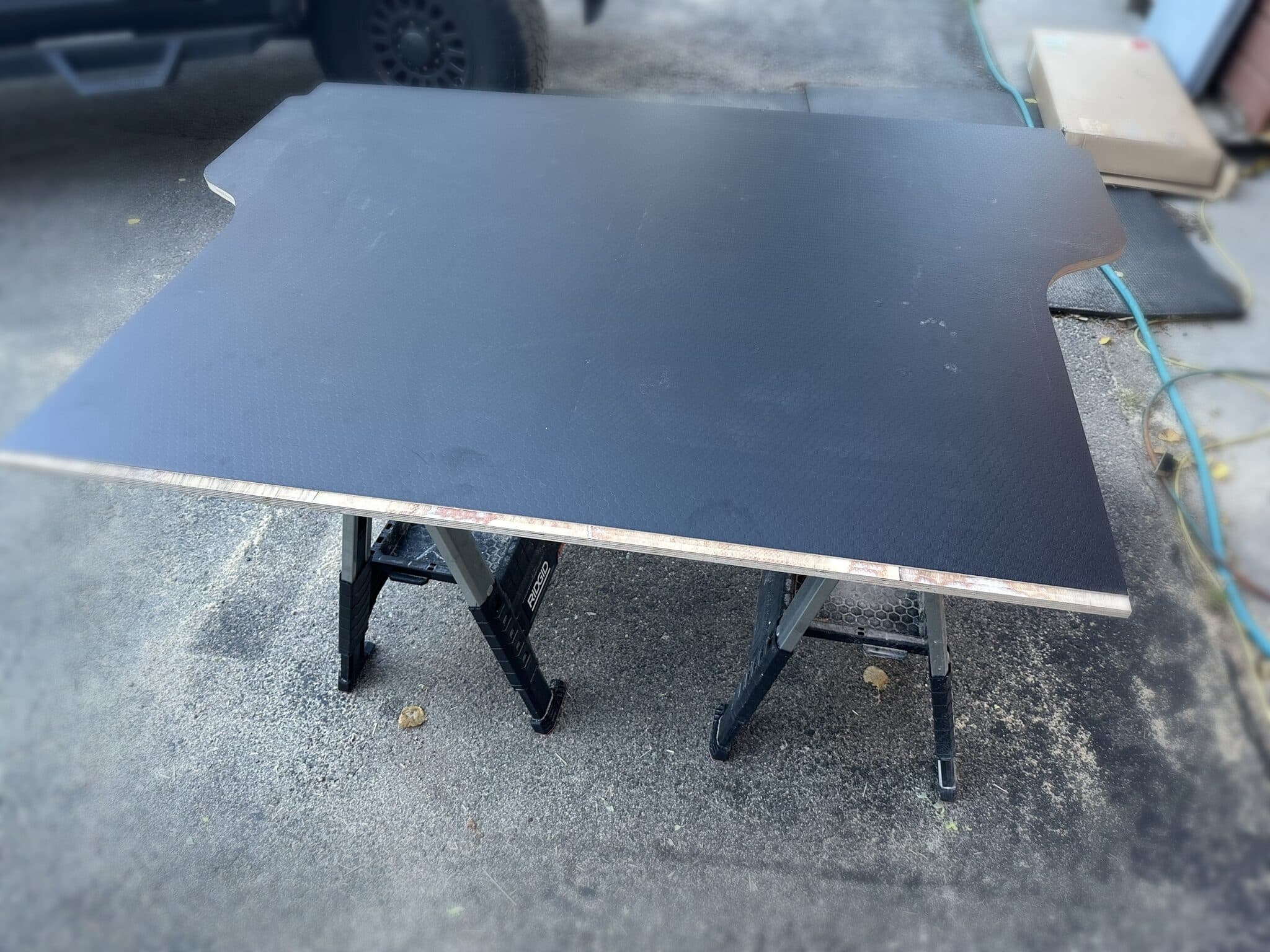
T-shaped plywood deck panel faced in black hex laminate resting on two folding sawhorses in the driveway, notched to fit around the truck bed's wheel wells.
The bed deck: Baltic birch faced in black hex laminate, cut to the bed's exact footprint.
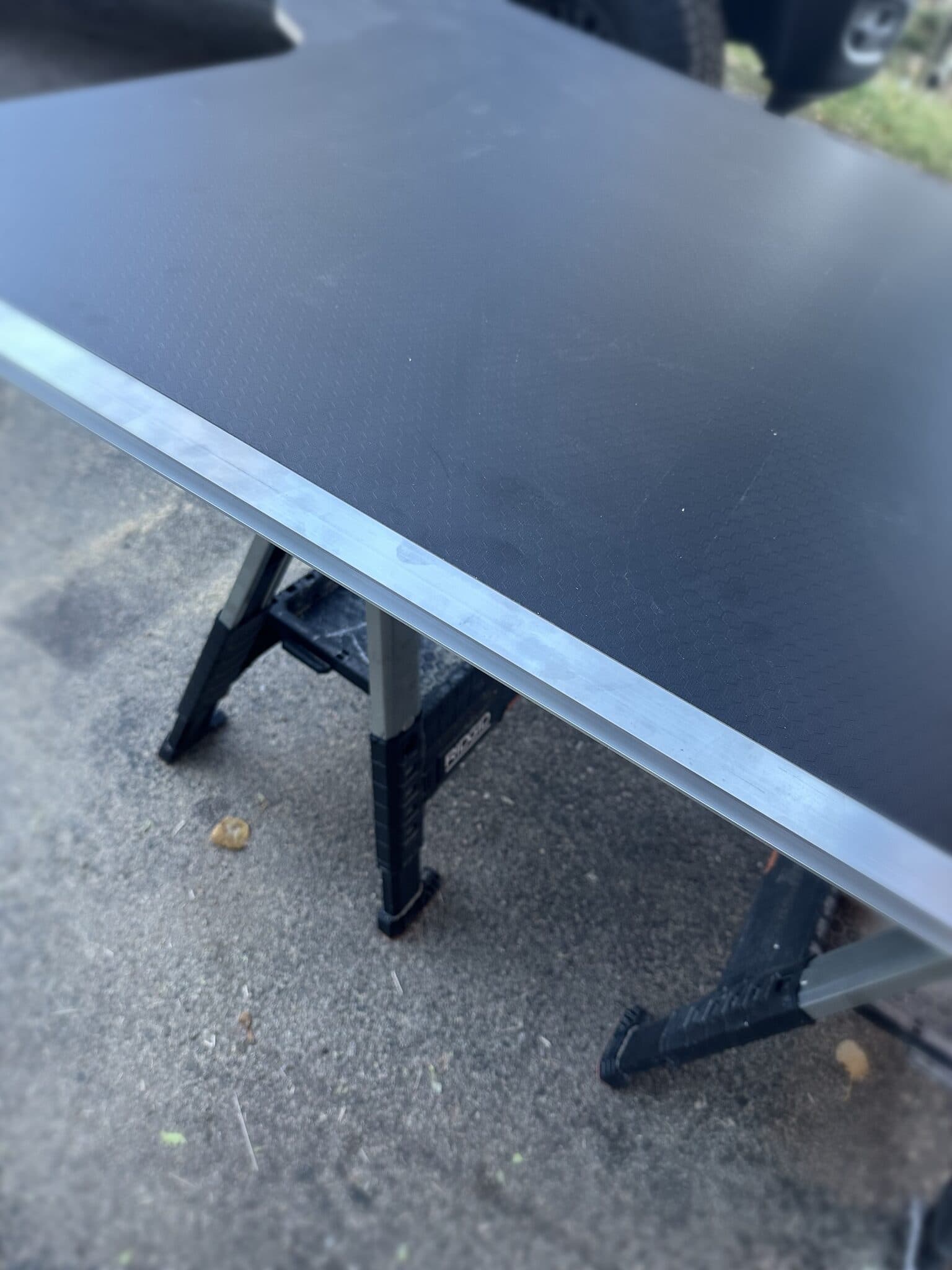
Close-up of the deck panel's edge on sawhorses, showing a brushed aluminum trim strip along the laminated plywood edge.
Aluminum trim protects the exposed plywood edge where gear slides in and out.
The two-piece deck panel joined at a glue seam, laid flat on a living room tile floor over foam insulation board with a 20-kilogram bumper plate weighting the joint.
The two-piece deck glued flat in the living room — a bumper plate makes a fine clamp.
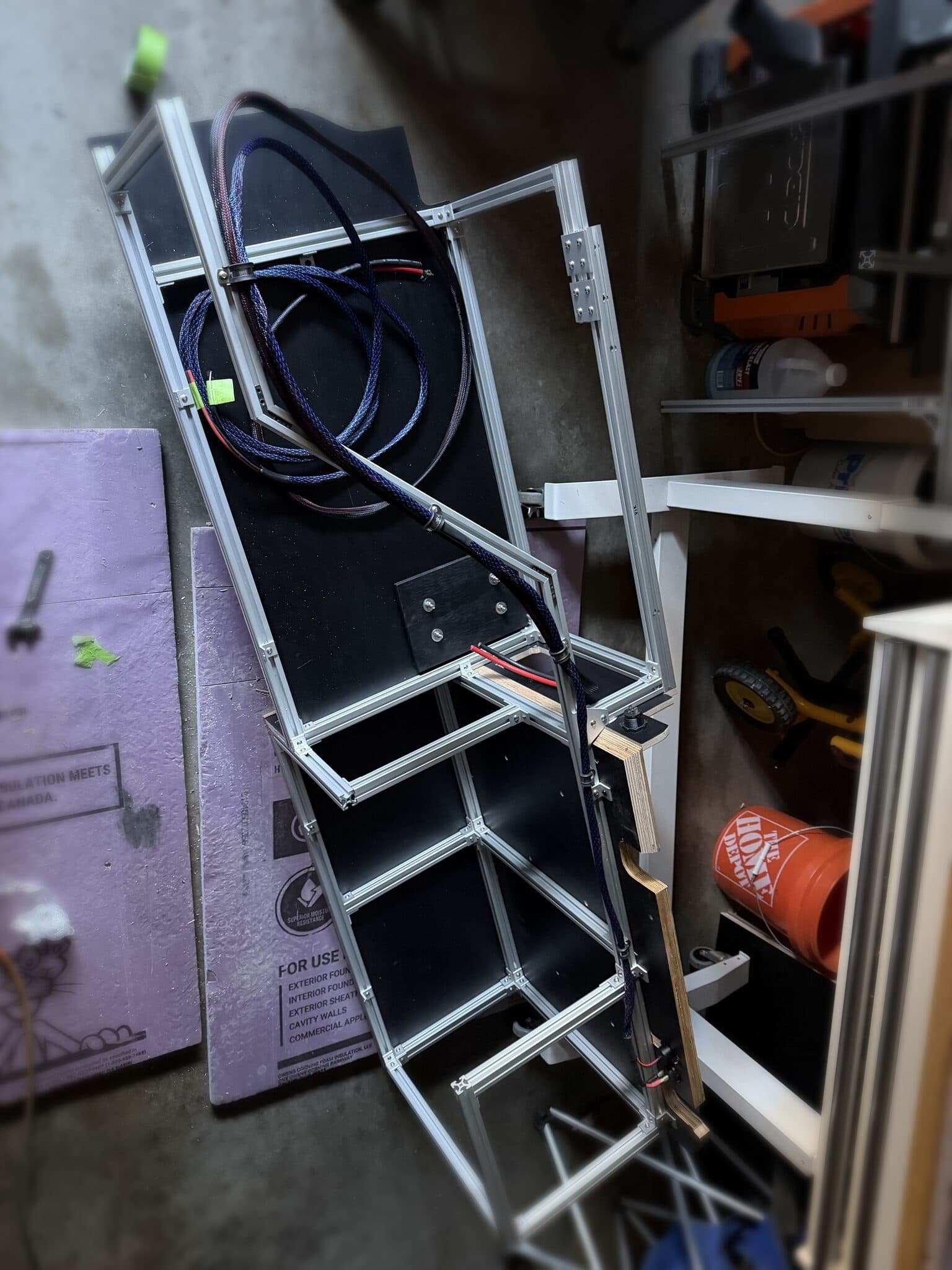
Storage module built from T-slot aluminum extrusion skinned in black laminate plywood, leaning in the garage with braided-sleeve wiring looms routed through the frame.
Each cabinet is a T-slot aluminum frame skinned in laminate ply, wiring pulled in braided sleeving.
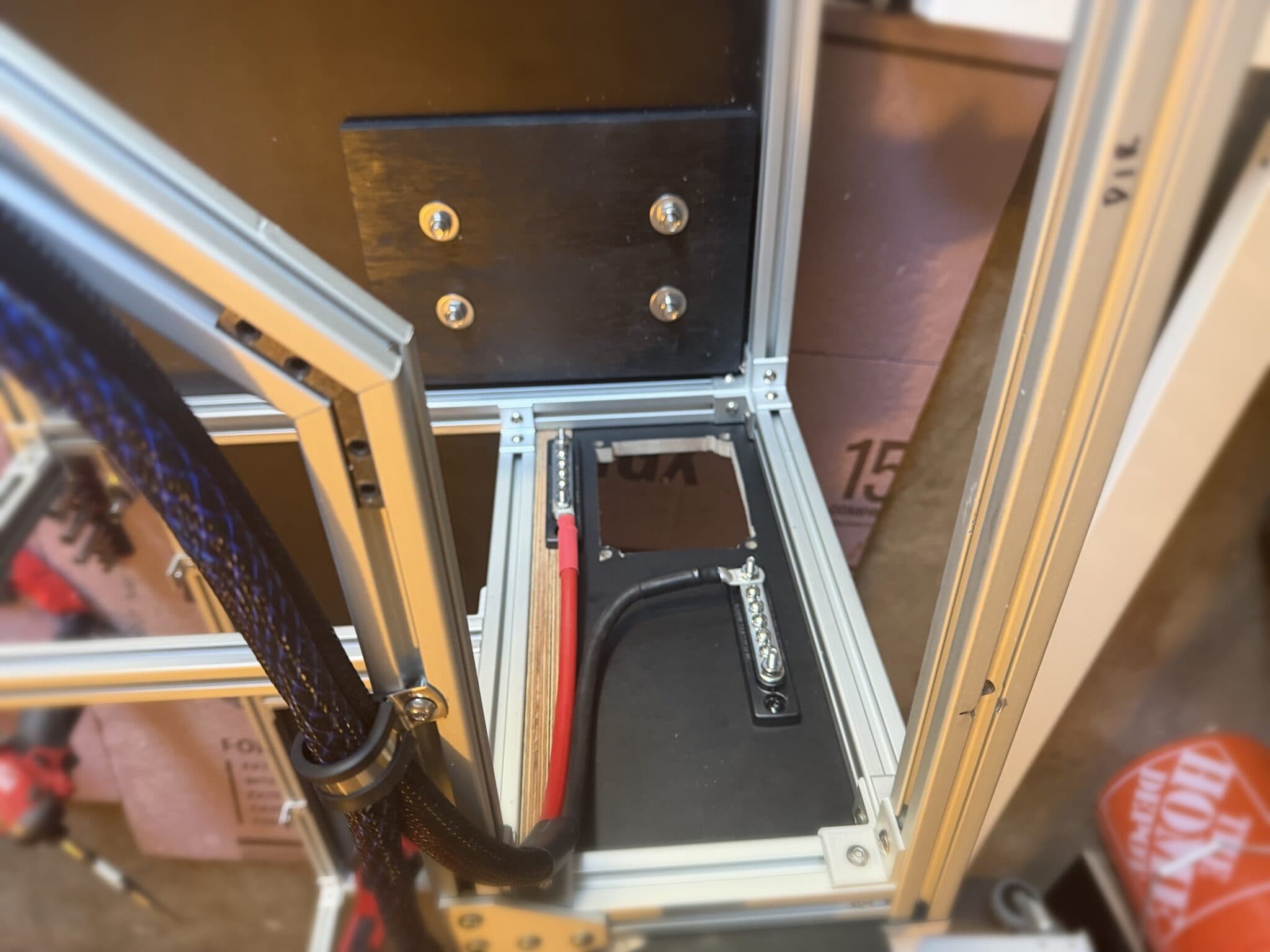
Inside a module frame: a tin-plated copper busbar mounted through a cutout in the black panel with a heavy black cable landed on one end.
Busbars mount through panel cutouts so the heavy DC runs stay short and serviceable.
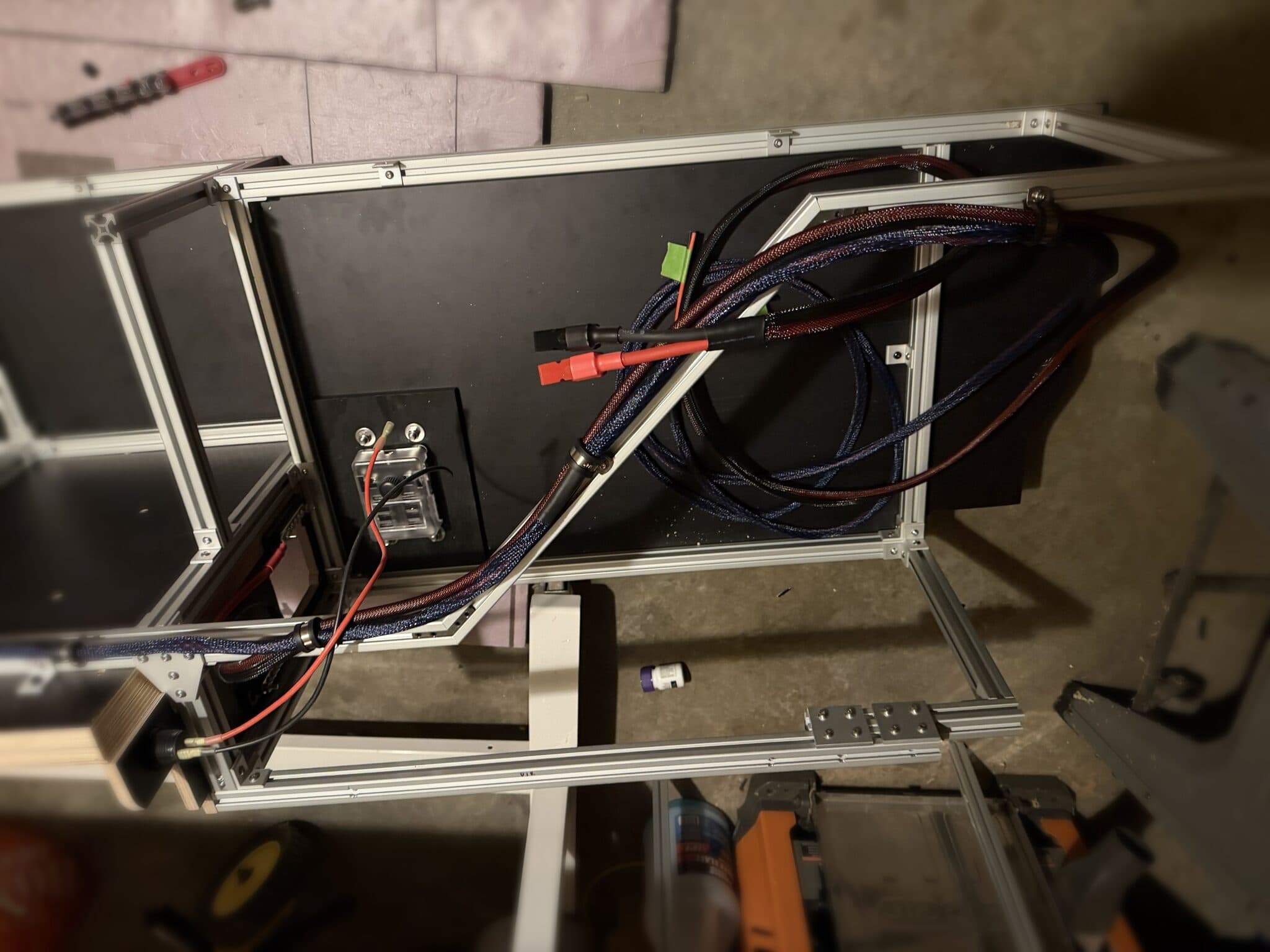
Module frame on the garage floor with sleeved power cables terminated in Anderson-style connectors, routed through strain-relief glands to a 12-volt outlet panel.
Quick-disconnect power runs, glanded and strain-relieved, so modules lift out without cutting wire.
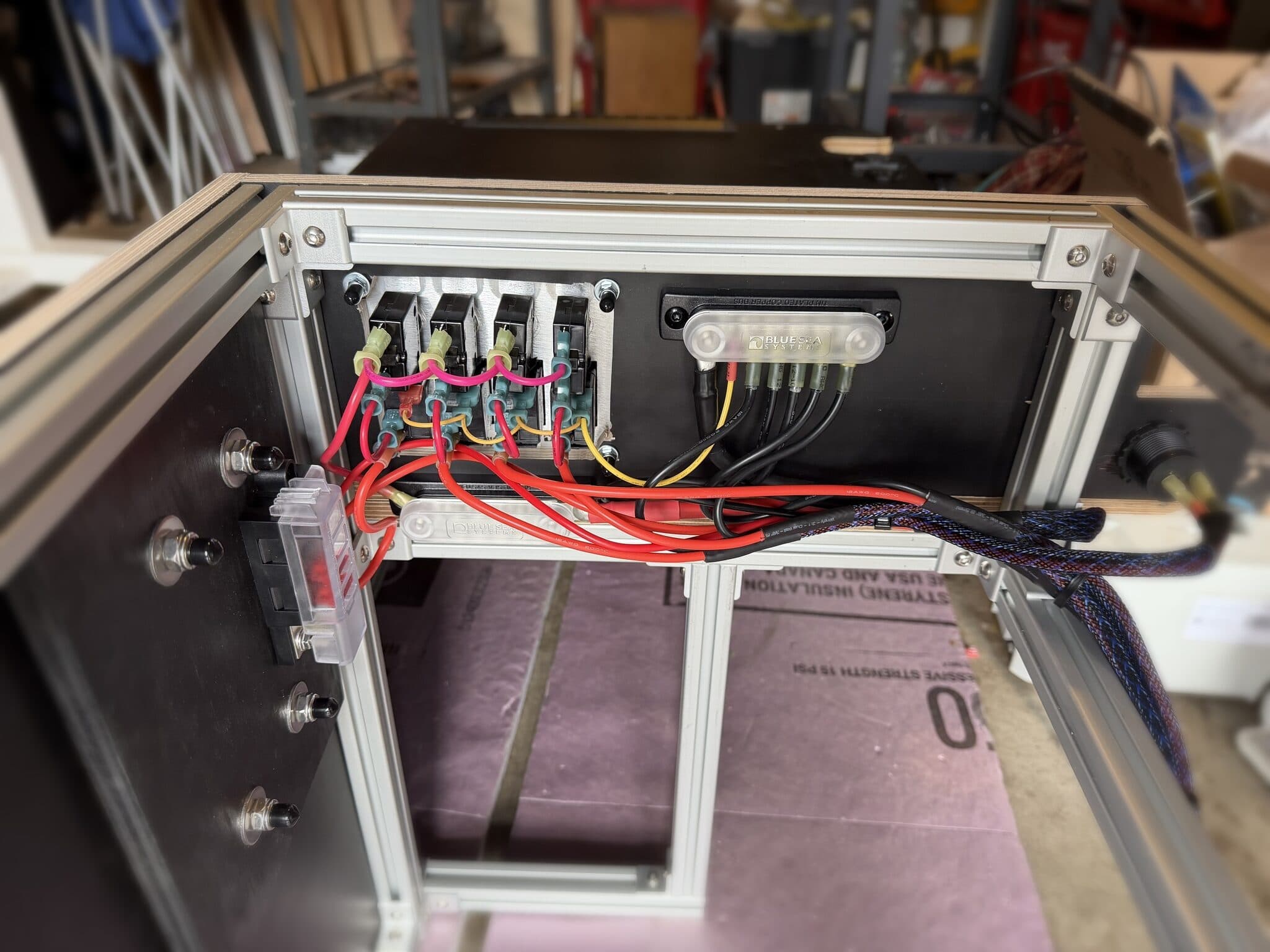
Back side of the switch panel: four rocker switches wired with pink and red leads to Blue Sea fuse blocks and a tin-plated busbar, with a 12-volt accessory socket at right.
Behind the switch panel: every circuit lands on a Blue Sea fuse block, nothing floats.
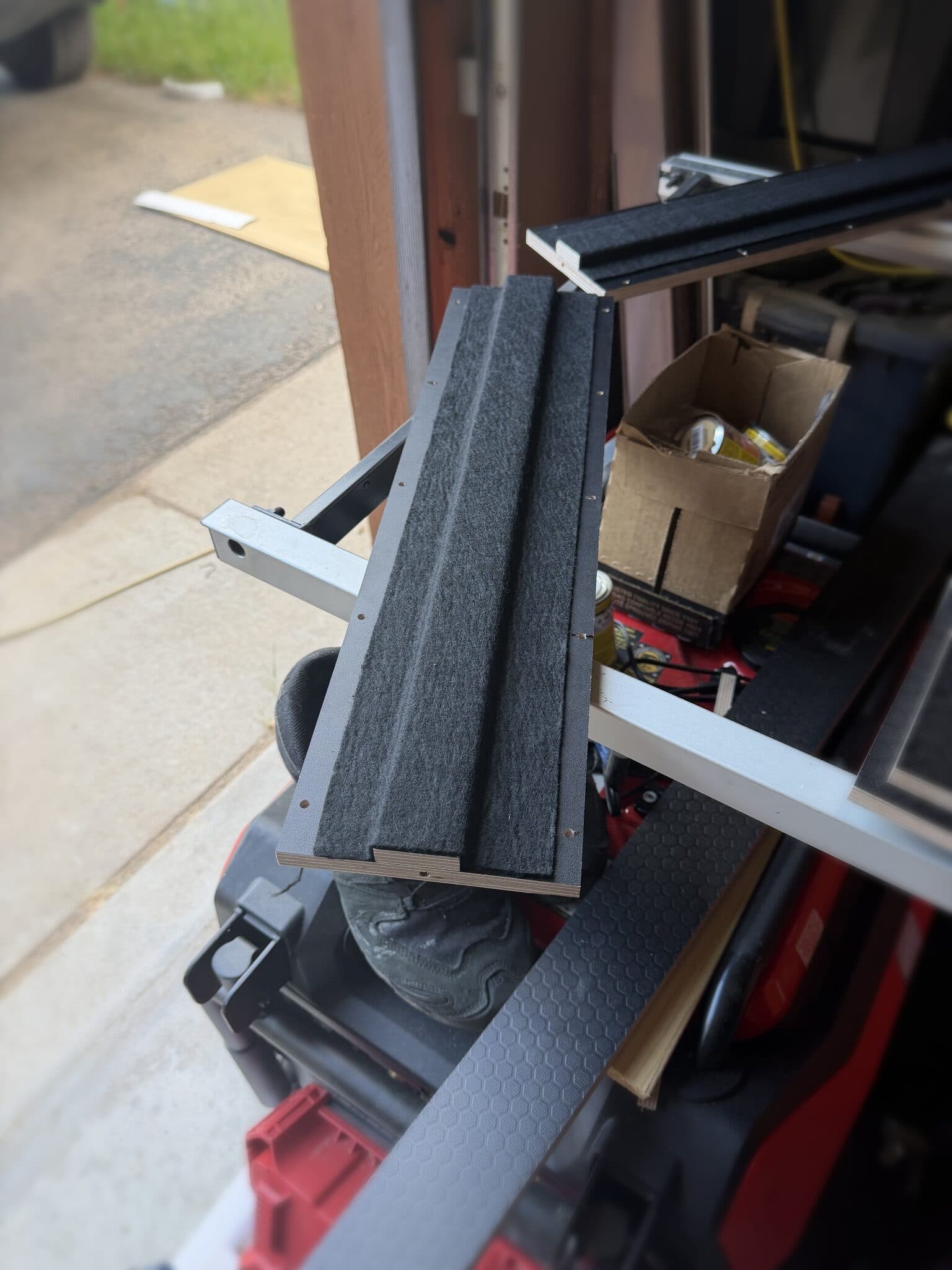
Plywood rail piece with felt-lined channels resting across the garage doorway, drilled for mounting screws.
Felt-lined channels seat the removable panels — nothing rattles on washboard roads.
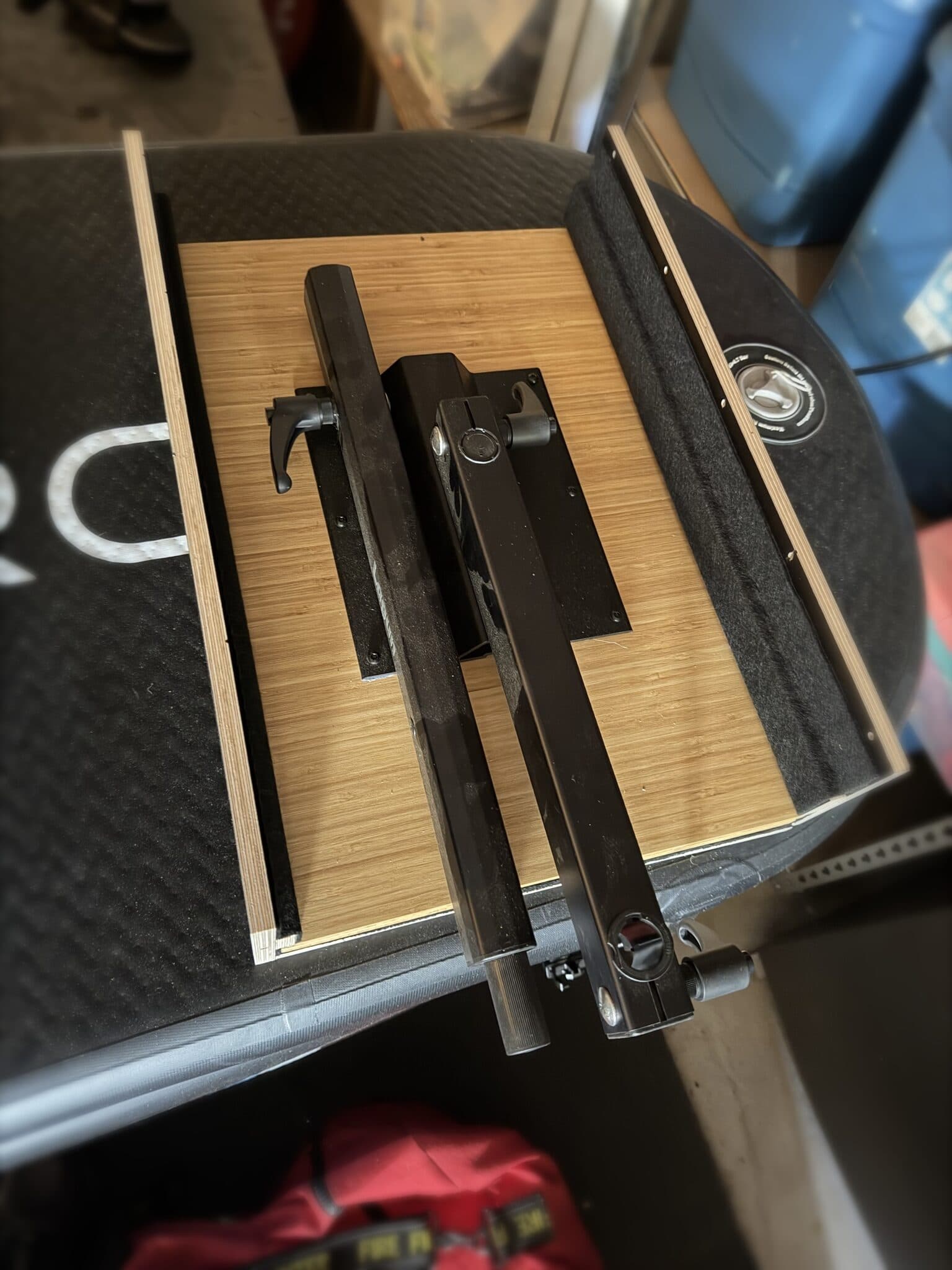
Lagun swing-arm table mount hardware laid out on a bamboo mounting board between two felt-lined plywood rails.
The Lagun swing-arm mount on its bamboo backing board, ready to install.
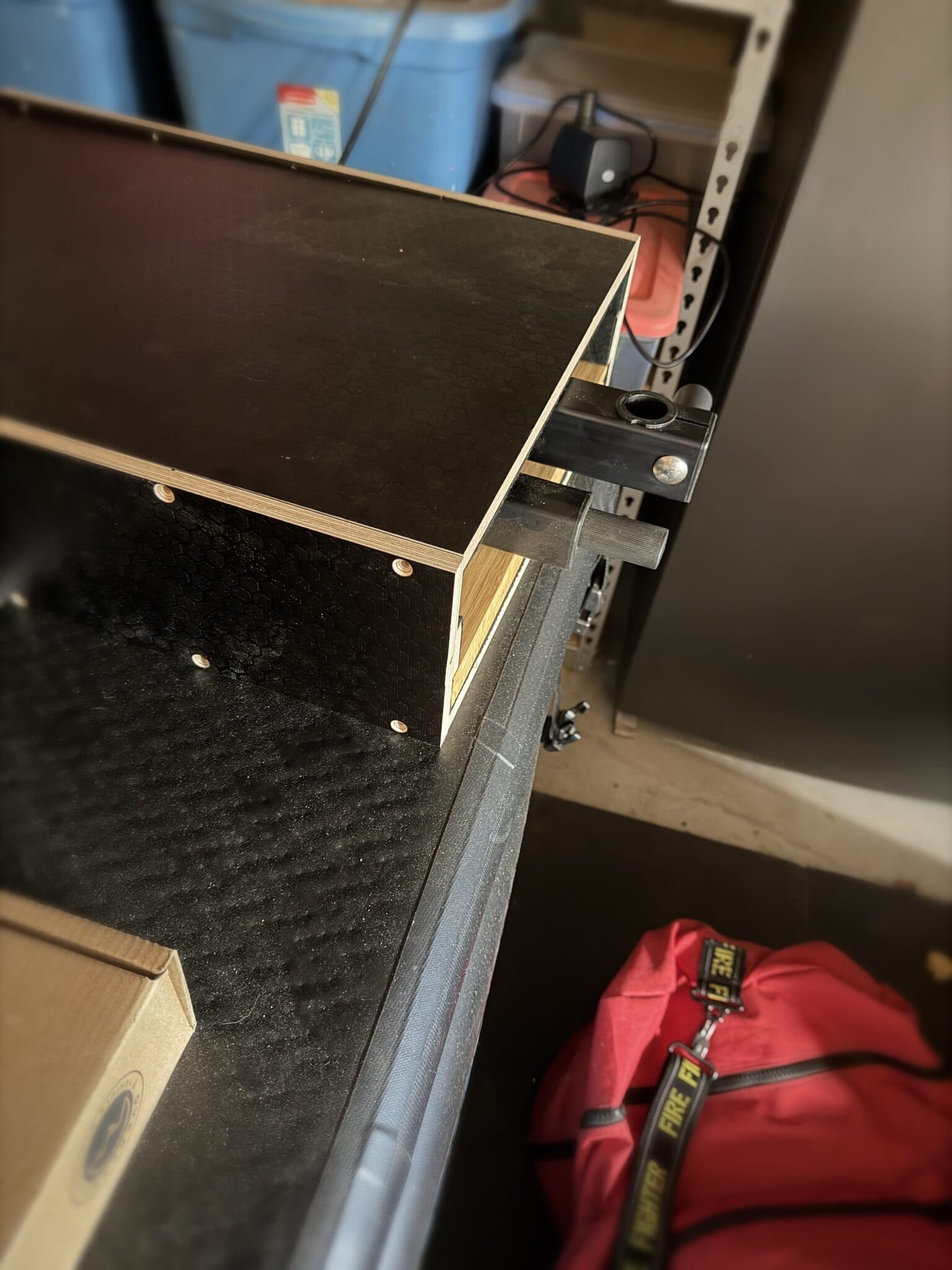
Corner of a hex-laminate plywood bench box with the table arm's square receiver tube clamped to its edge.
The table arm drops into a receiver on the bench box edge — rigid when set, gone in seconds.
Handheld solar panel multimeter clipped to a panel showing Pmax 550.7 watts, Vmp 64.27 volts, Imp 8.57 amps, and Voc 78.17 volts.
Bench-testing the array before it went up: 550 watts confirmed on the driveway.
Corner of the plywood cabinet at the open tailgate showing a weatherproof solar input port with an MC4 connector and red wire, next to a latched access panel with stainless hinges.
Solar lands through a weatherproof port at the bed rail — MC4 in, no pinched wires.
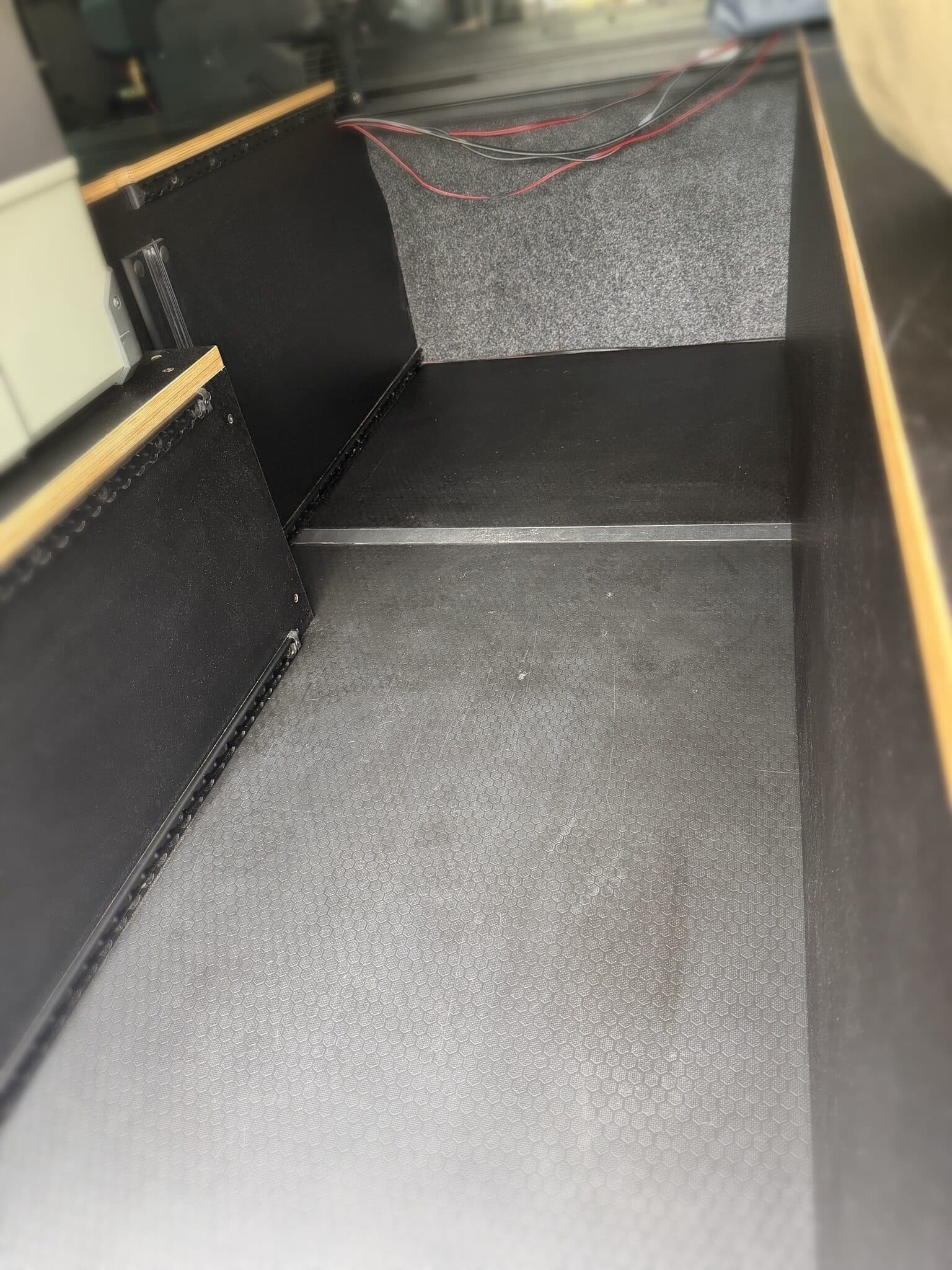
Finished storage bay inside the camper: hex-laminate floor and side panels with carpeted walls and wiring waiting at the back corner.
A finished bay: laminate floor, carpeted walls, wiring staged for the next module.
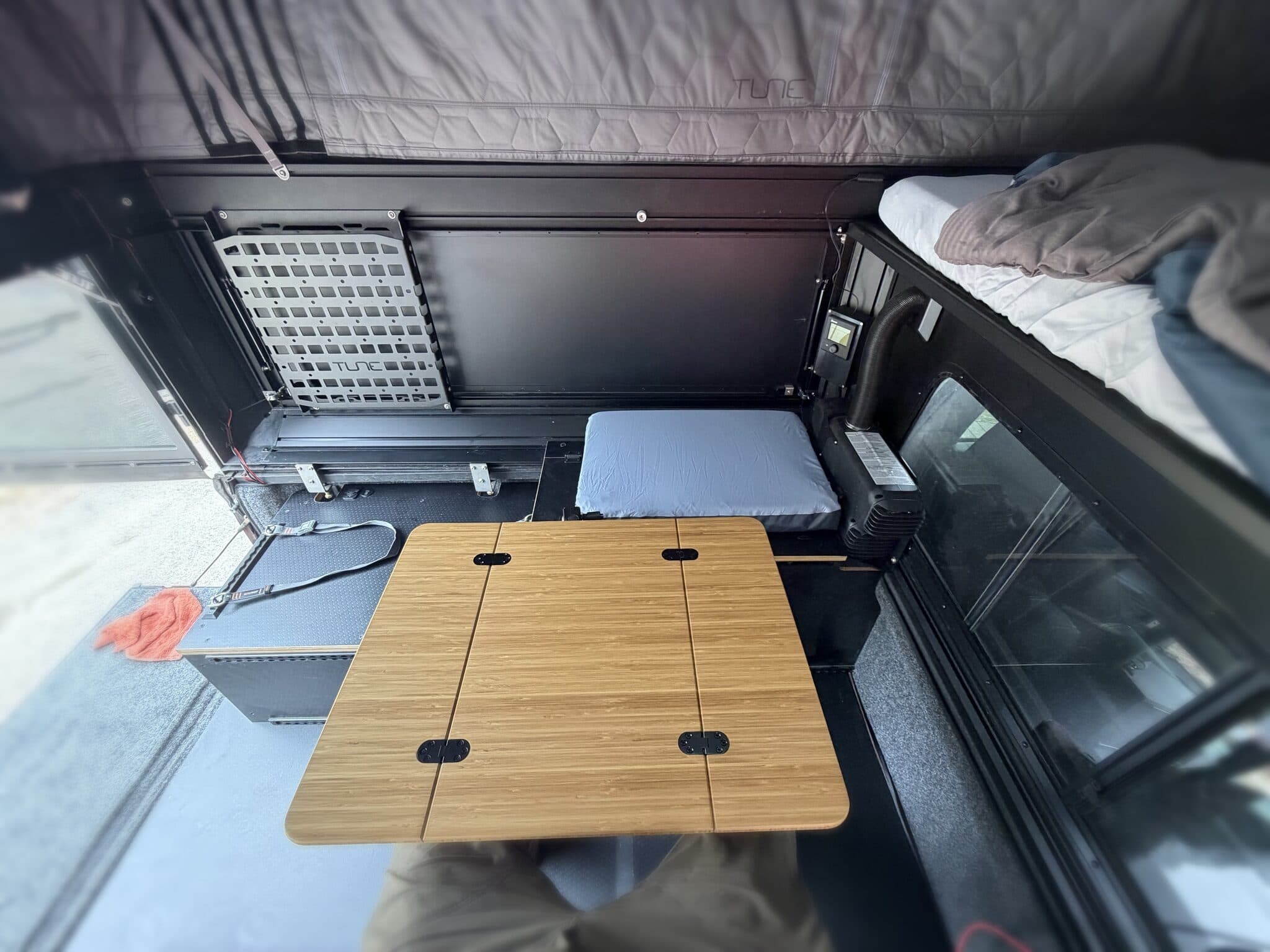
Camper interior with the pop-top up: bamboo Lagun table deployed over the bench, cushion and bunk made up, diesel heater ducting at right.
The table swung into place — office by day, dinner table by night.
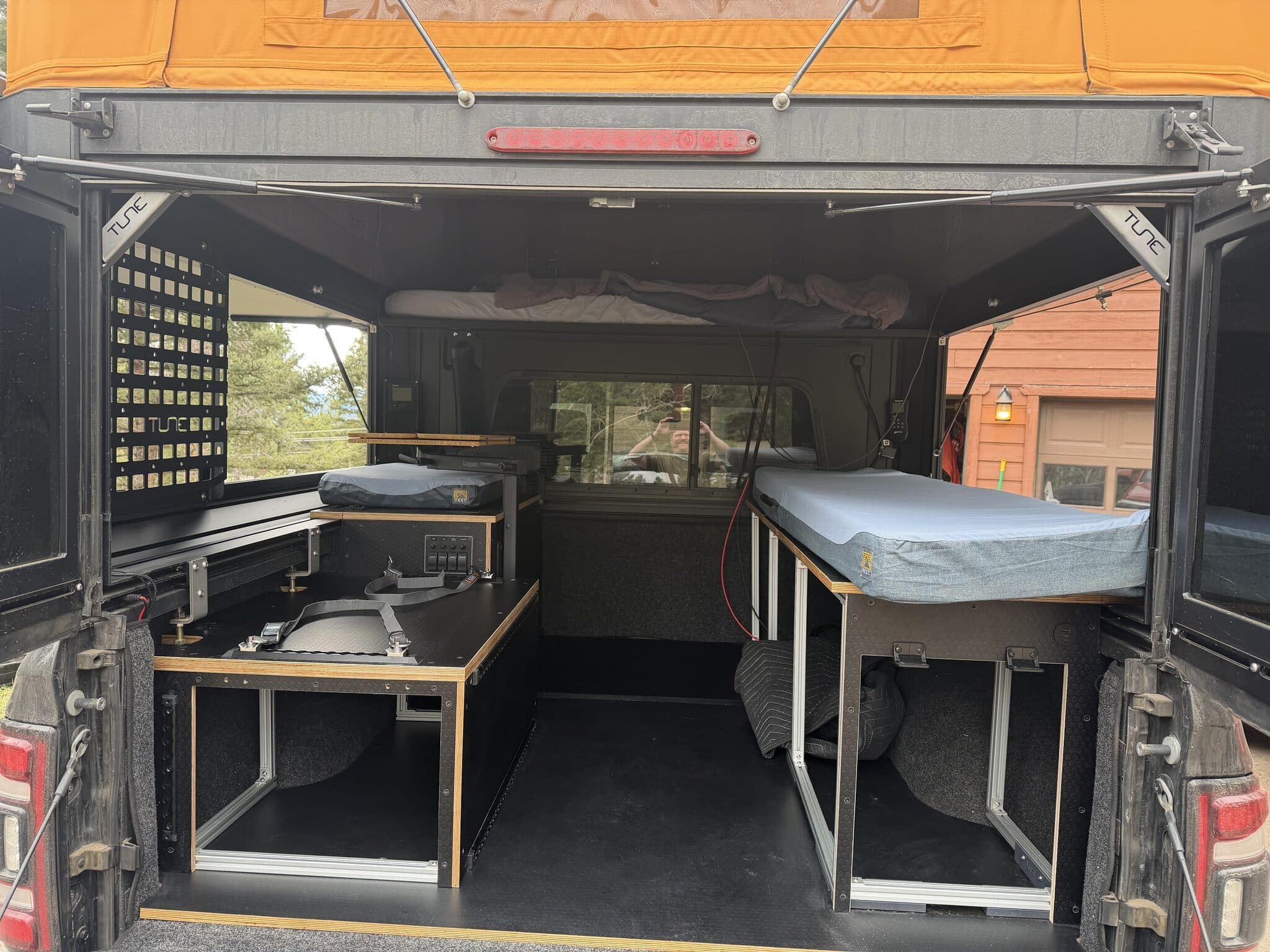
Rear of the camper with both doors open showing the finished build: bench modules on each side, mattress platforms, molle panel, and switch panel installed.
Both modules installed: sleeping platforms, benches, and the electrical all in place.
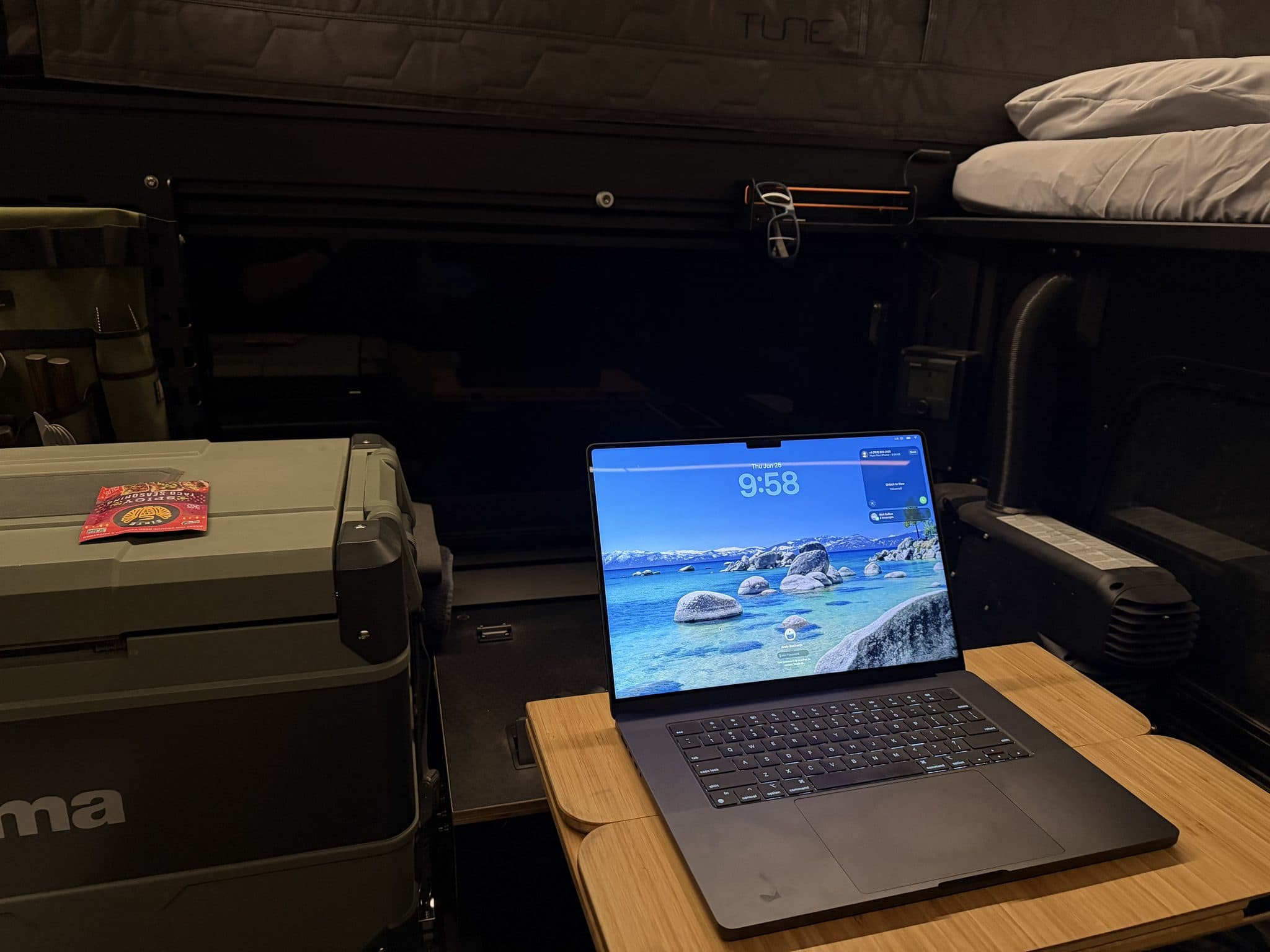
Camper interior at night: laptop open on a bamboo table, fridge at left, made bed at right — everything running off the house battery.
The payoff: a working evening off-grid, everything on the house battery.
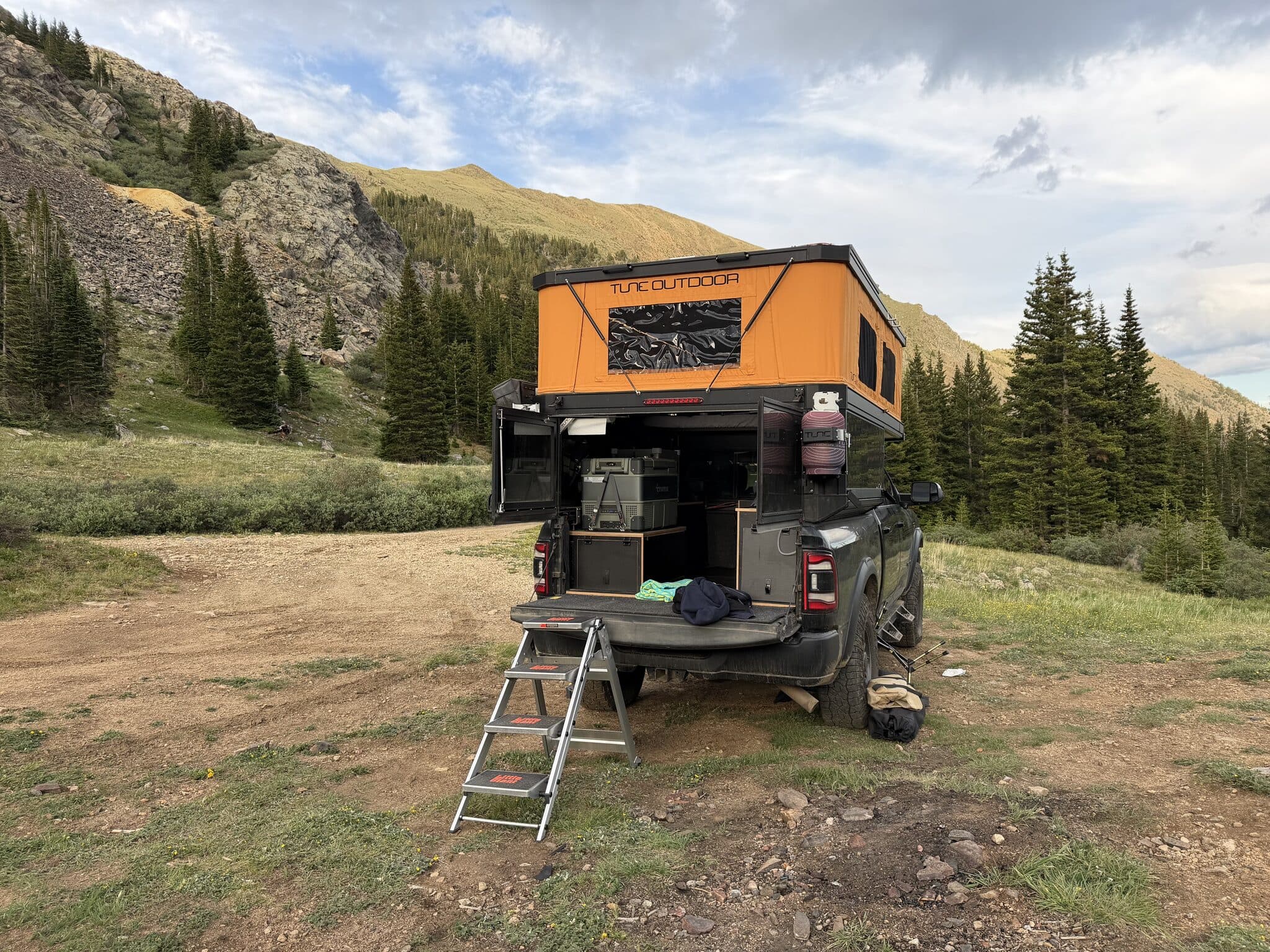
The truck camper parked in a high alpine valley with the orange pop-top raised, tailgate down with folding steps, and evergreen slopes behind.
What it's all for: basecamp above treeline.